If you’ve ever looked at two resumes that sound equally impressive, you already know the problem: resumes are summaries.
They can tell you what someone claims to know.
They rarely prove how someone performs when real work shows up.
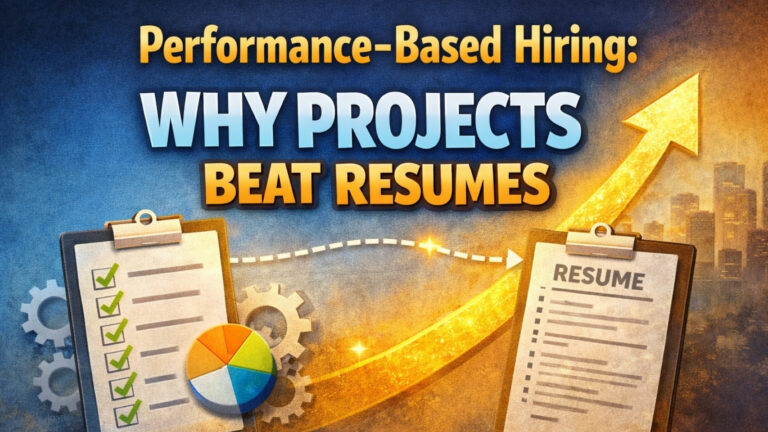
That’s why performance-based hiring is becoming a practical way to reduce guesswork: employers evaluate candidates based on contribution, demonstrated skills, and deliverables -through actual work.
On Qollabb, this idea is reflected through employer-driven industry projects where students work on real problems faced by companies, and employers can evaluate students based on project performance. The result is a clearer, work-based signal -useful for students, universities, and companies.
This blog explains:
- what performance -based hiring means in simple terms,
- why projects reveal what resumes can’t,
- how students can stand out through project performance,
- and how universities and companies can run this model more effectively.
What Is Performance -Based Hiring?
Performance -based hiring is exactly what it sounds like:
Hire based on performance – not just profiles.
Instead of relying heavily on resumes and interviews to predict ability, employers evaluate how a student performs while working on a real project:
- Do they deliver on time?
- Do they communicate clearly?
- Can they collaborate?
- Can they improve with feedback?
- Is the output usable?
This doesn’t mean resumes disappear. It means the project becomes a strong evidence layer -something that makes hiring decisions more grounded.
Why Projects Reveal What Resumes Can’t
A resume can say:
- “Team player”
- “Strong analytical skills”
- “Built a prototype”
- “Worked on strategy”
A project shows:
- whether you can turn a vague brief into a plan
- whether you can handle constraints and ambiguity
- whether you can meet milestones consistently
- whether you can take feedback and refine your output
- whether your final deliverable is clear, complete, and review -ready
This is one reason Qollabb positions projects as employer-driven work based on real challenges -where the evaluation can be based on contribution and demonstrated skills during execution.
How Performance -Based Hiring Works in a Project Model
Here’s the simplest way to understand how project-based evaluation becomes a hiring pathway.
1) Companies define real projects
Companies create projects that reflect real needs – so the work isn’t hypothetical.
A solid project brief usually includes:
- the problem statement
- expected deliverable (report, prototype, analysis, deck, etc.)
- constraints (timeline, tools, data availability)
- success criteria
2) Students choose projects aligned to goals
Students perform better when projects align with:
- their interests,
- their current skill foundation,
- and the role they want next.
This is also where Qollabb’s matching approach matters: projects are meant to be discoverable and aligned to student profiles and skills, so students can pick up relevant work.
3) Mentorship improves execution quality
Mentorship isn’t “motivation.” It’s a feedback system that improves deliverables.
Qollabb’s model includes mentor involvement and guidance during the project -so students don’t operate in a vacuum, and work quality can improve through feedback.
4) Progress tracking keeps projects accountable
Projects succeed more often when progress is visible:
- milestones,
- updates,
- and deliverable quality over time.
This reduces last -week panic and makes performance easier to observe.
5) Employers evaluate performance and shortlist based on evidence
Instead of guessing from resumes alone, employers can evaluate:
- what was delivered,
- how it was delivered,
- and how the student performed throughout the project.
In Qollabb’s positioning, strong project performance can lead to internship or full-time opportunities, and evaluation is grounded in actual work.
What Gets Evaluated (So You Can Prepare Smart)
If you want to stand out in performance -based hiring, don’t optimize for “completion.” Optimize performance.
In Qollabb’s evaluation framing, project performance is assessed using defined criteria such as:
- creativity
- innovation
- teamwork
- timeliness
- quality of deliverables
That’s a helpful checklist for students, too. If you work deliberately across these dimensions, your output becomes easier to trust -and easier to shortlist.
Student Playbook: How to Stand Out in Performance -Based Hiring
Here are practical steps you can use on any project to perform better (and make your work easier to evaluate.
1) Make progress visible weekly
A common mistake is working silently for weeks and hoping the final deliverable speaks for itself.
Instead, send a weekly update (even if no one asked):
Weekly update template
- What I completed this week (3 bullets)
- What I’m doing next (2 bullets)
- What I need feedback on (2 questions)
- Blockers (if any) + what I tried
- Next deliverable (date + format)
Why this helps:
- it signals timeliness
- it proves accountability
- it makes teamwork visible
- it prevents misalignment from growing quietly
2) Turn feedback into visible improvements
The fastest way to look “hire -ready” isn’t doing everything perfectly. It shows that you can improve quickly and cleanly.
When you receive feedback, don’t respond with “done.”
Respond with evidence of improvement.
Feedback -to -improvement format
- Feedback received: ______
- What I changed: ______
- Where it changed: ______
- Why this improves the output: ______
This is how you convert mentorship into performance.
3) Write a contribution statement (especially for team projects)
Employers struggle to evaluate team projects when “we did it” hides what you did.
At the end of the project, write:
Contribution statement (5 -7 bullets)
- What I owned end -to -end
- Key decisions I made
- Problems I solved
- What I delivered
- What I improved after feedback
- How I contributed to team outcomes
This makes your role unmistakable -and makes evaluation fairer.
4) Package the project like a professional deliverable
A great project can still look weak if it’s presented poorly.
A clean project package includes:
- a 1 -page summary (problem → approach → output)
- the final deliverable (deck/report/prototype)
- a short walkthrough video or demo script
- a “what I’d improve next” section
This is what turns “a project” into a portfolio asset.
5) Create a simple proof bundle
Even when you don’t want to overload someone with material, you should make the work easy to verify.
Proof bundle
- final output link
- 2 -3 milestone screenshots or versions
- feedback notes + what changed
- your contribution statement
This is the difference between “trust me” and “here’s the evidence.”
What Universities Gain (When Projects Are Run Well)
When universities support employer -driven projects, the biggest advantage is not just “industry exposure.” It’s structure and outcomes.
A well -run project model gives universities:
- clearer oversight of progress
- more consistent evaluation across batches
- stronger student outcomes through structured delivery
- better alignment between academic goals and industry expectations
This is also why real-time visibility and clear evaluation criteria matter: they make programs easier to run at scale and easier to improve over time.
What Companies Gain (Why This Helps Hiring Teams)
Companies benefit because projects create better hiring signals.
Instead of relying primarily on interviews and resumes, companies can evaluate:
- contribution
- quality of deliverables
- timeliness and reliability
- teamwork and communication
- improvement through feedback
This reduces hiring risk and increases confidence -because decisions are based on observed execution, not only on claimed experience.
Where Certification Fits
In Qollabb’s model, completed projects can also lead to certification that highlights:
- role and contributions
- skills demonstrated during execution
- feedback/ratings based on work performance
That matters because it gives students a portable artifact that reflects demonstrated performance, not just participation.
Performance -based hiring works for one simple reason:
It evaluates reality.
Projects show execution. They show communication. They show ownership. They show improvement.
For students: treat the project like a job – weekly visibility, feedback loops, deliverable quality.
For universities: build consistency through structured implementation and oversight.
For companies: shortlist based on evidence, not just resumes.
If you want the strongest version of your career story, don’t just list skills.
Demonstrate them.