How Industry Projects Are Transforming Education, Hiring and Career Readiness
The relationship between education and employment is undergoing a fundamental shift. Degrees alone are no longer sufficient to demonstrate readiness for the workplace. Employers increasingly seek proof of skills, universities face pressure to improve placement outcomes, and students want meaningful experience before graduation.
Industry projects are emerging as a powerful solution that connects these needs. By bringing real business challenges into academic environments, industry projects enable students to gain practical experience, help universities deliver outcome-driven education, and allow companies to evaluate talent through real performance rather than resumes.
This model is reshaping how education, hiring, and career preparation work together.
The Growing Skills Gap Between Education and Industry
Across global job markets, employers consistently report that graduates lack practical workplace readiness. While academic institutions provide theoretical knowledge, companies operate in fast-moving environments that demand applied problem-solving, collaboration, and adaptability.
Traditional learning models often struggle to keep pace with industry expectations because:
- Curricula evolve slower than industry trends
- Students have limited exposure to real business problems
- Hiring decisions rely heavily on resumes and interviews
- Internship opportunities are limited and not scalable
As a result, students graduate with qualifications but without demonstrable experience, creating a gap between education and employability.
Industry projects address this gap by embedding real-world work directly into learning journeys.
Why Universities Are Moving Toward Industry Collaboration
Higher education institutions are increasingly measured by student outcomes, particularly employability and placement success. Universities are now expected to prepare students not only academically but professionally.
Industry collaboration helps institutions achieve this by introducing experiential learning models that align education with real market needs.
Key benefits for universities include:
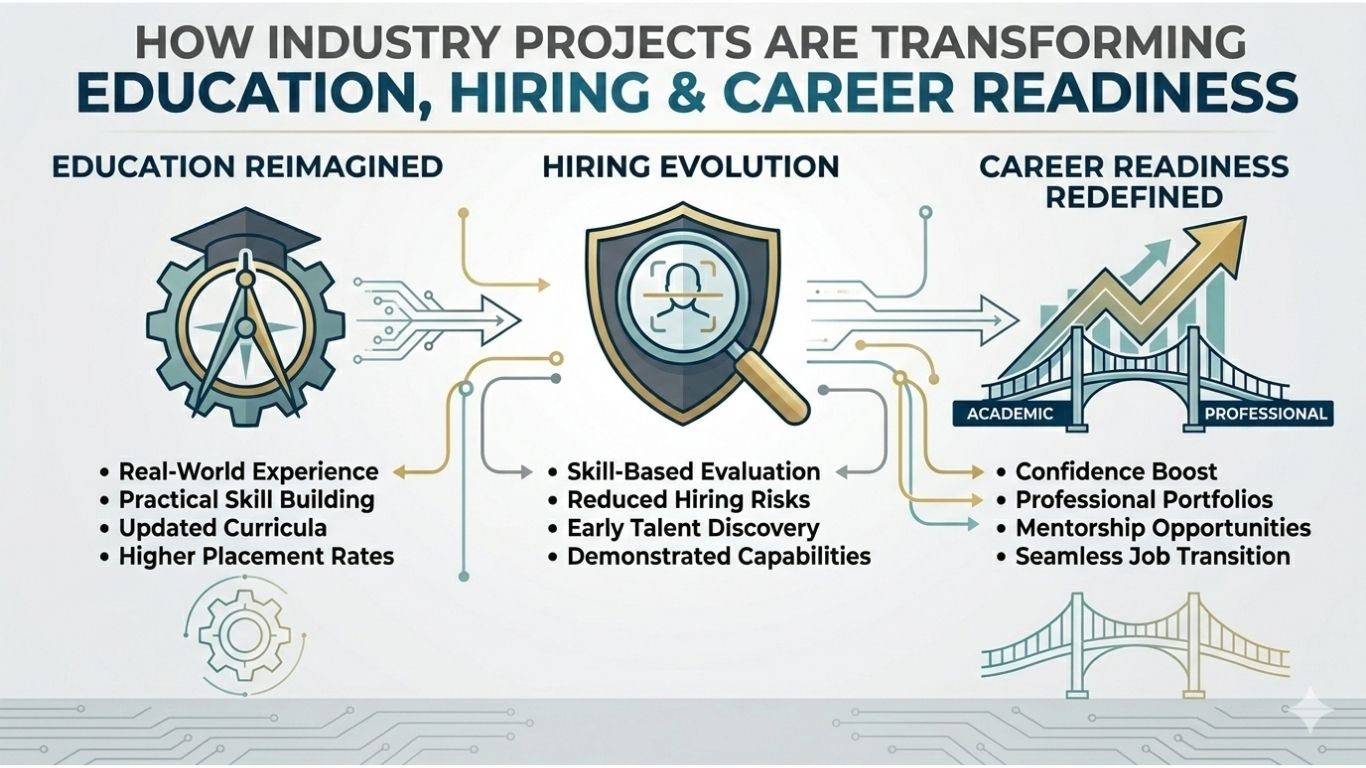
- Improved placement outcomes through practical exposure
- Stronger industry partnerships
- Curriculum relevance aligned with employer expectations
- Enhanced institutional reputation as industry-aligned educators
Employer-driven projects allow institutions to integrate practical learning without completely redesigning academic structures. Students apply classroom concepts to real challenges, strengthening both understanding and confidence.
Why Companies Prefer Project-Based Talent Evaluation
Hiring based solely on resumes and interviews often fails to reveal real capabilities. Employers increasingly recognize that skills are best evaluated through demonstrated work.
Project-based evaluation enables companies to:
- Observe problem-solving abilities in real scenarios
- Assess collaboration and communication skills
- Evaluate consistency and accountability over time
- Identify high-potential candidates early
Instead of relying on hypothetical interview answers, organizations gain insight into how candidates actually perform. This reduces hiring risks and improves recruitment quality.
Industry projects therefore function not only as learning tools but also as talent discovery mechanisms.
How Industry Projects Work
Industry projects connect three stakeholders within a structured ecosystem:
- Employers define real business challenges based on organizational needs.
- Students select or are matched to projects aligned with their skills and interests.
- Mentors and academic stakeholders guide execution and evaluate outcomes.
Throughout the project lifecycle:
- Students work on real deliverables
- Mentors provide structured feedback
- Progress is monitored through measurable milestones
- Performance insights help evaluate skills objectively
Platforms such as Qollabb enable this process by connecting universities, companies, and students within a single collaboration environment, ensuring scalability and structured outcomes.
Benefits for Each Stakeholder
Universities
Industry projects strengthen institutional impact by linking academic learning with professional outcomes.
Universities benefit through:
- Higher student engagement
- Improved employability metrics
- Stronger employer relationships
- Data-driven insights into student performance
Institutions move from knowledge delivery to career readiness enablement.
Corporates
Organizations gain access to emerging talent pools without committing to traditional recruitment processes.
Key advantages include:
- Early identification of skilled candidates
- Reduced hiring uncertainty
- Exposure to innovative student perspectives
- Efficient talent pipeline development
Companies evaluate capability through real contribution rather than credentials alone.
Students
For students, industry projects provide opportunities traditionally limited to internships.
Students gain:
- Real-world experience before graduation
- Practical portfolios demonstrating skills
- Mentorship from industry professionals
- Confidence entering the job market
Instead of competing solely on academic grades, students showcase proven abilities.
The Shift From Degrees to Demonstrated Skills
The global workforce is transitioning toward skills-based hiring. Employers increasingly prioritize demonstrated competencies over academic credentials alone.
Industry projects support this shift by enabling:
- Portfolio-driven evaluation
- Continuous skill validation
- Practical learning environments
- Outcome-based education models
Students build evidence of capability, universities deliver measurable outcomes, and employers gain hiring confidence.
The Future of Education and Recruitment
The future of education lies in integrated ecosystems where learning and working are no longer separate phases. Advances in technology are accelerating this transformation through:
- AI-driven project matching
- Real-time performance analytics
- Scalable mentorship systems
- Data-informed hiring decisions
Industry collaboration platforms are becoming infrastructure layers connecting academia and employment markets.
As organizations seek adaptable talent and students pursue meaningful career preparation, experiential models will continue to replace purely theoretical education pathways.
Conclusion: Bridging Learning and Employment
Industry projects represent a structural evolution in how talent is developed and discovered. They align the goals of universities, employers, and students within a shared ecosystem focused on real outcomes.
By integrating practical challenges into education, institutions prepare graduates for modern careers, companies discover capable talent earlier, and students transition into the workforce with confidence and proven skills.
The future of career readiness will not be defined by what students study alone, but by what they build, solve, and deliver during their learning journey.
FAQs
What are industry projects for students?
Industry projects are real-world assignments created by companies that allow students to apply academic knowledge to practical business challenges while gaining professional experience.
How do industry projects improve employability?
They provide hands-on exposure, measurable performance outcomes, and portfolios that demonstrate real skills valued by employers.
Are industry projects better than internships?
Industry projects complement internships by offering scalable, structured, and performance-based learning opportunities accessible to larger groups of students.
Recommended Images (with Alt Text)
- Industry academia collaboration workflow diagram
- Project-based learning model for universities
- Student industry project lifecycle illustration